Alchemical Vessels of the Wixárika
The Wixárika” (we-rar-ee-ka) are an indigenous group who live in the Sierra Madre Occidental mountain range in Central Western Mexico. They are known by their Spanish name, Huichol, but they refer to themselves as “Wixárika”; ’the people’. Unlike most Meso-american indigenous groups, the Wixárika have retained their ancestral spiritual practices and beliefs despite the ongoing trauma of colonization.
The Wixátari are known as “A Nation of Shamans” because of the large number of shamans in their population, and the leading role they have played in their communities since pre-Hispanic times. They follow traditions of their ancestors and mediate between the world of the living and the supernatural world of the ancestors and a family of deities. According to the Wixárika, everything is family. The gods are family. Grandfather Fire and Grandmother Earth; who created the people - they are immanent; guiding and supporting their people. Ancestors are seen as not just the ones they share a DNA profile with, ancestors are all living beings, including all gods and spirits. Everyone and everything on the other side is an ancestor, because it is all related.
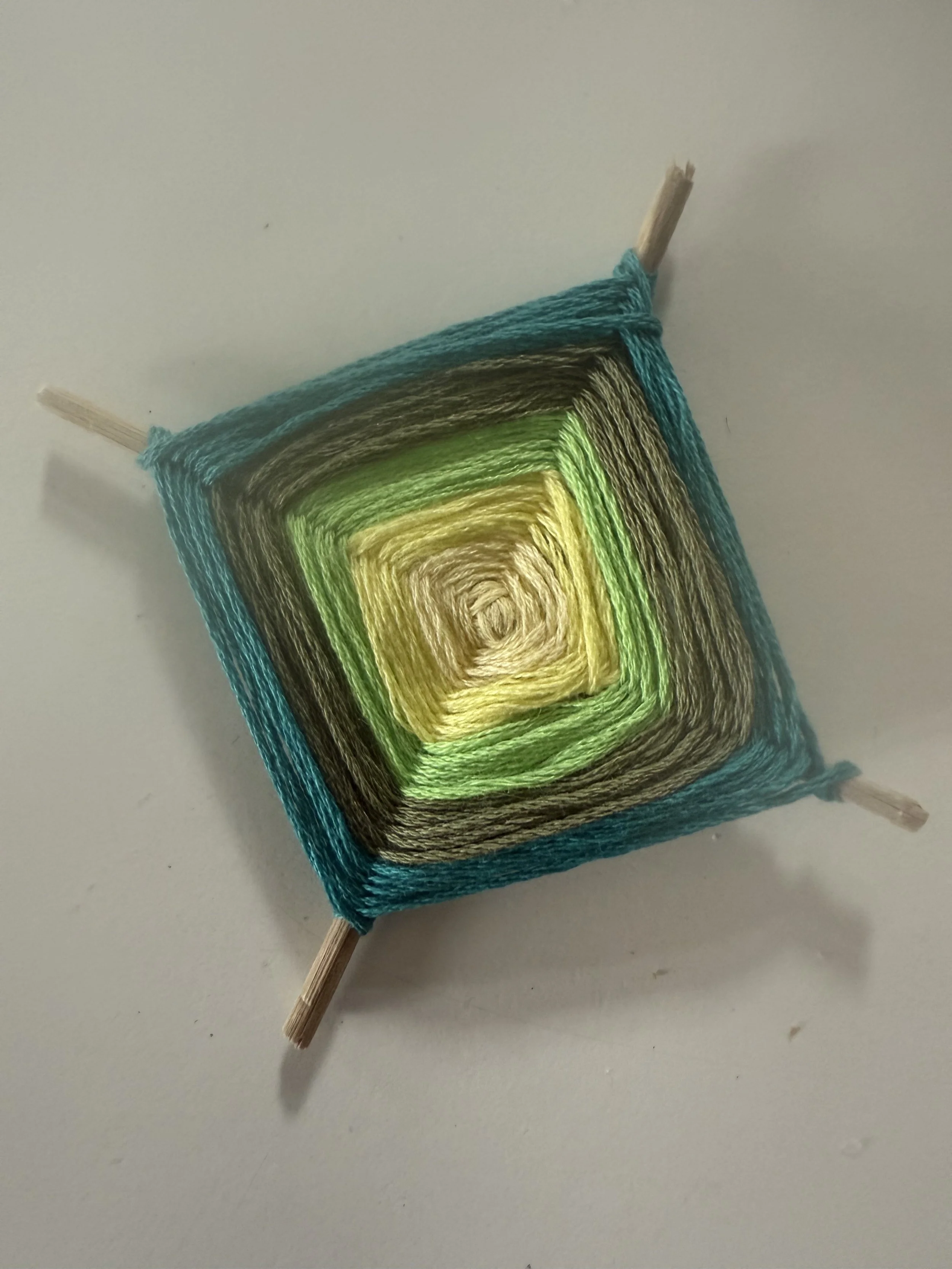
Wixárika artists, both commercial and sacred, produce incredibly complex and brightly colored yarn paintings, beaded sculptures and the mandala-like yarn art called tsikuri (sih-koory). The tsikuri is a recognizable form, known in the arts and crafts world as a “Gods Eye” or “Ojo de Dios”. The basic structure is 2 sticks crossed at right angles with yarn wound around it in various colors. (See fig 1, attached). The design of the tsikuri is a representation of the harmony of the elements, earth, air, water, fire. The center point of the tsikuri is the focus for meditation or concentration. The 3 or 4 corner tsikuri is the basic foundation of more complex designs, many of which have 8 or more points. (See fig 2-4) With the more complex works, one can see that the tsikuri is a form of mandala - a circular design with points radiating from a center. According to Jung, ‘mandalas are among the oldest religious symbols of humanity” (C.W., vol 12, p.97). The purpose of a mandala is to activate the mind to focus on the present moment awareness and access a state of non-thinking inner peace. The center of the tsikuri is seen as the portal or doorway which opens to the otherworld where ancestors, animals and ritual implements are showing the way to a multi dimensional healing experience.